
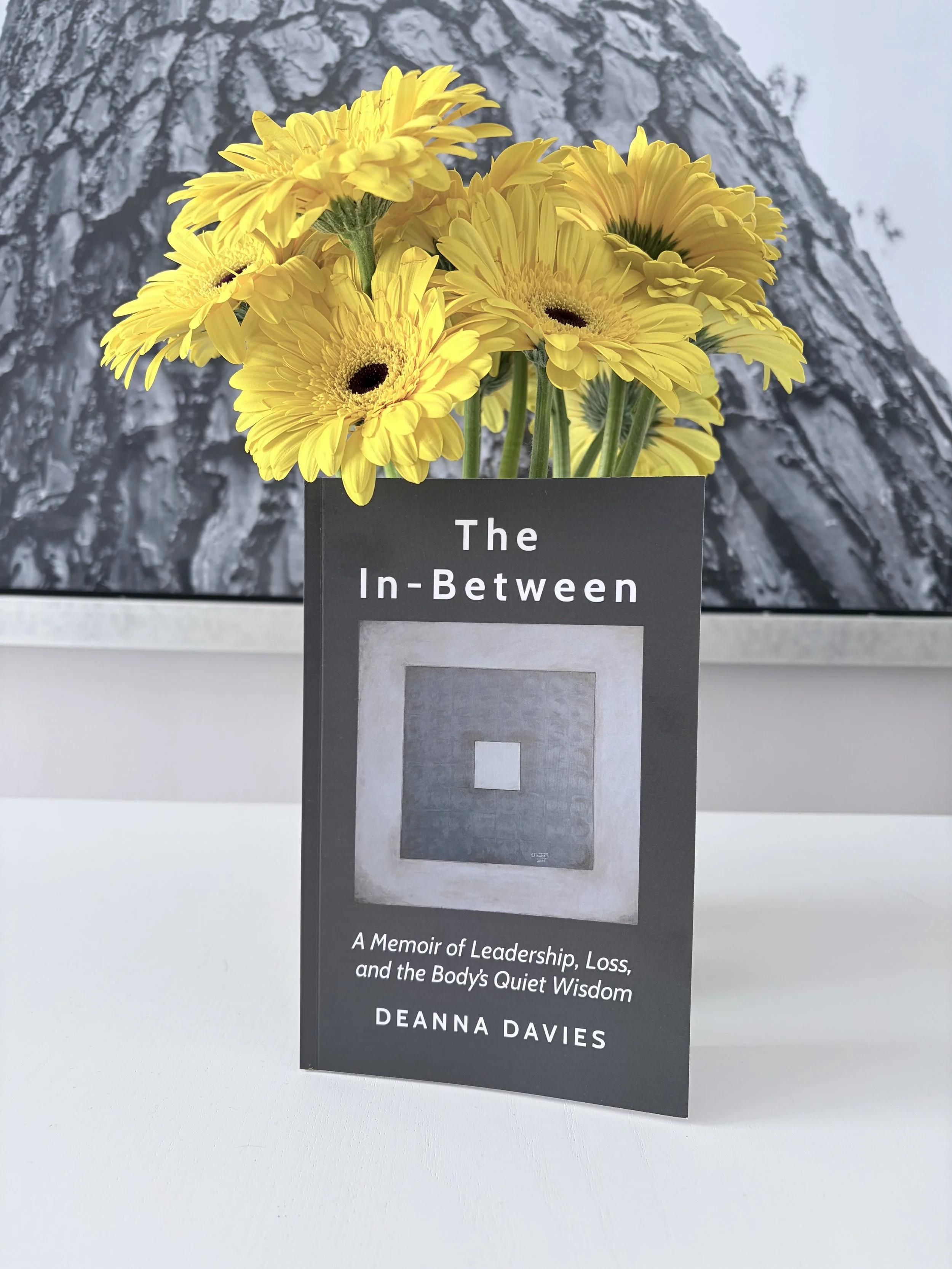
The In-Between
Now Available on Amazon
The In-Between
A book about loss, change, leadership, and the space between what was and what is becoming.
The In-Between is a deeply personal reflection on grief, caregiving, uncertainty, identity, and finding your way through change.
Written by Deanna Davies, the book began during one of the most difficult seasons of her life: walking alongside her mother through palliative care, navigating loss, and later facing a significant career transition.
Through journal entries, reflections, pauses, and restorative practices, The In-Between offers an honest look at what it means to be human in the middle of change.
It is not a book about having all the answers.
It is a book about learning to stay present, listen inward, make meaning, and keep moving forward with care.
About the Book
The In-Between invites readers into the tender and often uncertain space between endings and new beginnings.
Part memoir, part reflection, and part companion for change, the book explores grief, caregiving, leadership, resilience, self-trust, and the quiet strength required to move through life’s most difficult transitions.
The structure moves between personal story, reflective pauses, and grounding practices. These pauses create space for readers to consider their own experiences of loss, change, uncertainty, and becoming.
At its heart, The In-Between is about what happens when life does not go according to plan — and how we begin again, one honest moment at a time.
Why This Book Belongs in Conversations About Leadership and Change
Change is not only strategic. It is deeply human.
In organizations, projects, teams, and communities, people are often asked to keep moving while carrying uncertainty, grief, pressure, identity shifts, and invisible transitions.
The In-Between opens a different kind of leadership conversation — one that recognizes that people do not leave their humanity at the door.
For project leaders, change leaders, educators, caregivers, teams, and organizations, the book creates space to reflect on what it means to lead, support others, and stay grounded when the path forward is unclear.
Because plans change. People change. And leadership often happens in the space between what was expected and what is actually unfolding.
For Leaders, Project Managers, Teams, and Caregivers
The In-Between is for anyone navigating change, loss, uncertainty, or transition.
It may especially resonate with:
Leaders supporting people through change
Project managers and project leaders navigating uncertainty
Teams moving through transition, disruption, or renewal
Educators, facilitators, and helping professionals
Caregivers and members of the sandwich generation
People rebuilding after loss, identity shifts, or career change
Organizations seeking more human conversations about resilience, capacity, and care
You do not have to be in crisis to be in an in-between.
Sometimes the in-betweenis quiet.
Sometimes it is professional.
Sometimes it is personal.
Often, it is both.
Closing Keynote May 2026 PMI SWOC - The In-Between
Cultivated Spotify Lists for Restorative Practice
Pages 143-150 - I hope you enjoy them.
Quiet Rest - https://open.spotify.com/playlist/5ucJcr9BhQKrKZKwOJWd5O?si=nu33hY7XR6CAeNGkUIF3cQ
Rest November - https://open.spotify.com/playlist/1Ccc56kJriZ3HkKc8A8Lax?si=X3prDsEoRSWISJ3KgsFNZA
Rest & Restore Reset - https://open.spotify.com/playlist/1CqJuPiEgUFkcavmYbQkFo?si=chojZVwZTT-CgwAyguolXg
Summer Restore -
https://open.spotify.com/playlist/0BJtFOHPVY8ZnMXPMg6wY8?si=_KWNxQ5LS92OUebMaKdizA
Speaking, Readings, and Workshops
The In-Between can be brought into organizations, conferences, leadership events, retreats, classrooms, book clubs, and professional development spaces through customized readings, workshops, facilitated conversations, and keynote sessions.
Sessions can be designed around grief, change, resilience, leadership, caregiving, uncertainty, emotional capacity, and the human side of navigating transition.
These experiences are reflective, grounded, and interactive. They create space for people to pause, connect, and consider how they are moving through change — personally, professionally, and collectively.
Possible formats include:
Author readings and reflections
Keynotes on leading in the in-between
Reflective leadership workshops
Book club or team discussion sessions
Caregiver and resilience conversations
Restorative leadership retreats
Sessions for project leaders navigating change and uncertainty
Themes Explored
The In-Between explores themes that are both personal and deeply connected to leadership, change, and the way people move through uncertainty.
Themes include:
Grief and caregiving
Change, transition, and uncertainty
Leadership in difficult seasons
The sandwich generation
Identity and becoming
Emotional resilience
Rest, restoration, and capacity
Somatic awareness and grounding
The human side of project and organizational change
Beginning again after loss or disruption
Behind “The In-Between” with Deanna Davies
1. What first called you to write The In-Between, and why did it feel important to share this story now?
I started writing because I needed somewhere to place what I was living through.
There was so much happening at once. Caregiving, loss, change, uncertainty, and the quiet unraveling of things I thought I understood. At first, I did not think I was writing a book. I was trying to stay present. I was trying to make sense of what my body, my heart, and my life were asking me to notice.
Over time, I began to realize this was not only my story. I would sit in hospital waiting rooms and meet people who had that same look. The look of waiting, worrying, holding, not knowing. We may not have known each other’s full stories, but there was a quiet recognition between us.
So many people are living in some in-between. Between what was and what comes next. Between control and surrender. Between holding it together and quietly falling apart.
I felt nervous about sharing it because it is deeply personal, but I also felt that if it helped even one person feel less alone in their own season of uncertainty, it needed to be shared.
2. This book was written from inside a year of caregiving, change, and uncertainty. What did writing allow you to notice that you may not have seen otherwise?
Writing helped me slow down enough to notice what I was actually carrying.
When you are in the middle of caregiving, grief, work, responsibility, and change, you often just keep moving. You do what needs to be done. You respond. You manage. You stay strong because people are depending on you.
But writing and reflecting gave me a place to pause.
And when writing felt like too much, audio recording became another way of staying with the moment. Sometimes I would speak the words before I could write them. That helped me capture the emotion before I edited it, explained it, or made it more acceptable.
It helped me notice the small signals. The fatigue. The tightness. The moments where I was overriding myself. The places where my body was speaking long before my mind was ready to understand.
3. You describe this as embodied leadership from within. What does that mean to you, and how did your body become part of the story?
For many years, I understood leadership through the mind. Strategy, communication, emotional intelligence, decisions, relationships, and responsibility.
But this year taught me that leadership also lives in the body.
It lives in how we breathe before we respond. How do we notice when we are overwhelmed? How do we recognize the difference between urgency and importance? How do we stay present when we cannot control the outcome?
My body became part of the story because it would not let me keep pretending I was fine. It began to signal what I had been managing, minimizing, or pushing through.
That changed my understanding of leadership. I no longer see it only as what we do for others. I see it as how we stay connected to ourselves while carrying responsibility, change, uncertainty, and care.
4. What do you hope readers feel, recognize, or permit themselves to explore after reading this book?
I hope readers feel less alone.
I hope they recognize the places in their own lives where they have been holding so much, perhaps without naming it. I hope they begin to listen more gently to themselves, especially in times when they feel pressure to keep going, stay strong, or have everything figured out.
This book does not offer a perfect ending or a set of simple answers. That was never my intention.
I hope that it permits people to pause. To notice. To honour what their body and heart may already know. To understand that being
in-between does not mean they are lost. Sometimes it means something deeper is being revealed.
5. Where does The In-Between go from here, both as a book and as part of your larger work in leadership, reflection, and well-being?
I feel like The In-Between is only the beginning of a larger conversation.
The book began as a personal story, but it has opened a wider reflection on leadership, change, caregiving, uncertainty, and the human experience of holding responsibility when life does not offer clear answers.
I see it becoming part of my speaking, workshops, retreats, and leadership work through Elevate3.
I am especially interested in exploring what this means for leaders, project managers, educators, caregivers, and teams who are navigating change in real time.
So much of leadership focuses on action, outcomes, and moving forward. I want to create space for the quieter parts too. The pause. The body’s wisdom. The uncertainty. The grief. The growth that happens before we have language for it.
Where it goes from here is still unfolding, but I know it will continue to centre reflection, embodiment, leadership, and the courage to stay present in the in-between.
6. Why did you include the “In-Between Notes” throughout the book?
I included the “In-Between Pages” because they are something I have always wished for when reading reflective books.
There are moments when a sentence lands, or a question opens something, and I want a place to pause with it. Not just read past it, but sit with it for a moment.
The “In-Between Pages” were created for that reason. They invite the reader to slow down, notice what is coming up for them, and make the book their own in some way.
For me, reflection is part of the experience. This book was never meant to be rushed through. It was meant to be held, returned to, marked up, and lived with.
Those pages create space for the reader’s own story to rise alongside mine.
“The In-Between is incredibly relatable for anyone living in exactly that: the space in uncertain times, the grieving that begins before the loss itself, the pull of the sandwich generation, the quiet reckoning that comes with leadership. She names that space with such honesty that I felt seen on every page.
What strikes me most is her vulnerability. It is no small thing to take an experience like this and offer it to the world. Deanna lets us in while she is still in the in-between, with the outcome still uncertain, and that willingness to be seen mid-journey is exactly what makes the book so powerful. She gives us something incredibly powerful and useful: the truth of what it feels like to be in it.
This is a story of grief. But it is also a story of love. Love for her mom, and love for herself, and a deep recognition of the journey it takes to go all in on being present and caring for ourselves: mind, body, and spirit. Deanna provides excellent restorative and somatic practices that offer a practical way to take care of ourselves as we navigate our own in-betweens. And she is careful to name what that showing up really means. It isn’t leadership in the defined sense, the titles, the authority, or the performance of being in charge. It is something quieter and more human. Her reflections put words to feelings I carried through my own difficult seasons, things I had never been able to name until I read them here. The reflective pieces woven throughout the book gave me real pause and invited me to sit with my own story in a way few books do.
Because here is the gift in her honesty: when Deanna lays her experience bare, she makes room for ours. Her vulnerability becomes permission. Permission to admit we are struggling, permission to choose ourselves, permission to sit in the discomfort of not knowing what comes next. Every reader navigating their own in-between will find a companion in these pages, someone who has walked just slightly ahead and turned back to say, I see you, and you are not alone in this.
Deanna has an incredible way of showing up for the people around her, and The In-Between is a true testament to that gift. It is her showing up for all of us at once.
As someone standing in the in-between myself, this book spoke directly to my soul and handed me the tools to keep moving forward and grow. A beautiful tribute to her Mom, Laurie Mitchell. I cannot recommend it enough.”
Kellie Daniel
“Deanna’s debut left me reading through breakfast, (my tea and avocado toast staining pages), I couldn’t bear to put down—a personal memoir about loss, grief, resilience, leadership, and transformation.
The last chapters, her mother’s health dwindling, symbolism in nature, and metaphors appearing all around her got me very emotional and thinking about my relationship with my own mother and our quiet special moments.
Deanna’s “pause, breathe, notice” paradigm quietly dismantles everything we think leadership means. She introduces something brand new: stepping back from capitalist, production-focused working….towards tuning in.
The reflection questions at the end of each chapter belong in every mirror. In her chapter “When silence has a cost”, she made me feel that. The “In between” highlights the tremendous power of slowing down, tuning in, stepping back, and listening to our gut in moments of chaos.
If you are carrying the weight of leadership, grieving quietly while performing steadily, ignoring the signs your body is not OK, or simply wondering whether there is another way to walk through this world…buy this book.
Deanna shows us that the “in-between” is not a place to escape; it is a place to lead from.”
Ekta Singh
Reader Reflections
The In-Between has resonated with readers navigating grief, caregiving, leadership, change, and uncertain seasons of their own.
These reflections speak to the heart of the book: we are not meant to move through the in-between alone.
“A beautifully crafted guide to navigating loss with grace. The brilliant transition from journal entries to 'moments of pause' resonated with me profoundly, and the personal photos add such a touching, thoughtful layer to the book. I was especially moved by the letter of appreciation to the Providence caregiving team. Beyond the beautiful prose, the restorative practices offered are wonderful, practical tools that I am already implementing in my own home. Highly recommended!”
Tami Traynor
“When Deanna joined our CAAT Talespodcast for a segment on The In-Between, what struck me most was her ability to speak about uncertainty, loss, and transition with a grounded presence that made space for both truth and possibility. In sharing the story behind The In‑Between, she articulated the emotional terrain of change with a clarity that felt both deeply personal and universally recognizable. Her reflections on caregiving, leadership, and the quiet cost of silence revealed someone who understands not just the mechanics of change, but the human experience inside it.
Deanna brings a rare blend of emotional intelligence, reflection, and courage to every conversation. Listening to her describe the origins of her book — and the people she wrote it for — reminded me how deeply she honours the inner landscape of change and what it asks of us."
Julie White
"The In-Between is a gentle meditation on loss, which can be an incredibly reassuring resource for anyone facing grief or a difficult life transition."
Kathy Patterson
“The In-Between is one of those books that stays with you long after you finish it. Deanna’s honesty and vulnerability make you feel less alone, and the book offers a gentle reminder that it’s okay to sit with uncertainty instead of rushing toward answers. Her words are deeply comforting, creating space to reflect, breathe, and to simply be. It’s a beautiful read for anyone navigating change, grief, or life’s in-between moments.”
Marisa Mitchell
“I came to Deanna Davies’ memoir, The In-Between, at a time of personal transition, moving from a thirty-one year career to the world of retirement. Similar to the author, I also have been navigating caring for an elderly parent whose health is waning. So many aspects of this memoir speak directly to me; other aspects I am sitting with, and reflecting on the ‘quiet wisdom’ these nuggets contain. What a blessing this personal memoir is for me as a reader.
I’m sure many people can relate to the imbalance of competing commitments, and perhaps of values neglected when time gets away on us. As Deanna notes, what happens “when the body carries more than the mind can organize.
” When agency narrows, how do we respond? This is less a book with suggestions than with things to notice and reflect upon. The questions in this memoir for me, at least, have been so instrumental in reflecting on my own physiological and intellectual responses to a compression of time within growing responsibilities. The book has helped me to consider who I am in this new life along with who I want to be.
I am so grateful that Deanna has shared so much of her world and her wisdom. As I have told her, this memoir, albeit a “quick read”, is something I will continue to revisit for quite some time.”
Terri Daniel
“There are books we read, and then there are books that read us.
The In-Between by Deanna E. Davies, doesn’t just tell a story; it holds up a mirror.
I spent 3 hours this afternoon holding up that mirror cover to cover!
What struck me most was how clearly Deanna names the spaces leaders actually live in, the transitions, the tensions, the quiet moments where values are tested, and clarity is still forming. My own leadership has been shaped in those in-between places, navigating change, holding complexity, and learning to pause.
I’m especially grateful for Deanna, a dear friend and former colleague, whose wisdom, steadiness, and heart have shaped my own journey more than she knows. The In-Between reminds us that transformation isn’t a single moment. It’s the ongoing practice of staying present to who we are becoming.”
Paula Knight
"The In-Between" book is more than a book about loss and change. It is a thoughtful exploration of "Leadership during periods of transition". These are the three insights that resonated deeply with my own journey:
“Leadership begins with the ability to notice what is happening within us before what is happening around us.”
“When leaders are regulated, they create safety not by controlling outcomes, but by stabilizing presence.”
“Leadership is shaped by how we regulate our bodies.”
In a world that equates leadership with action and results, Deanna's book offers a totally different perspective: True leadership starts with presence, awareness and the ability to remain grounded amid uncertainty. Her message echoes a well-known story about Nelson Mandela. When the small propeller plane carrying him during the 1994 campaign experienced an engine failure, panic spread among passengers. Mandela remained calm and continued reading his newspaper, projecting stability when it was needed most. After a safe landing amid a sea of emergency fire trucks, Mandela privately acknowledged to his biographer: “Man, I was terrified!”
A powerful reminder that leadership is often about managing one's presence. Highly recommended for leaders navigating change.”
Tauofik Mounib